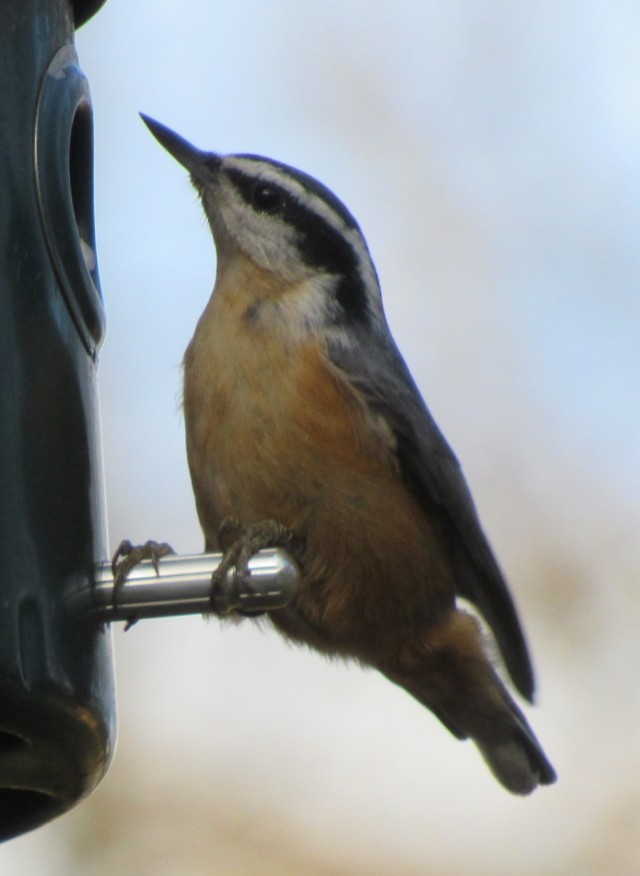
This is a sharp looking little bird that I occasionally see while visiting Brecksville Reservation; it also sometimes attends our birdfeeders. Around here it is not as common as the White-breasted Nuthatch.

The Red-breasted Nuthatch is a blue-gray bird with a strongly patterned head. It has a black cap and stripe through the eye broken up by a white stripe over the eye. The underparts are rich rusty-cinnamon in color and more pale in females than in males.
This bird lives mainly in coniferous forests of Spruce, Fir, Pine, Hemlock, Larch and Western Red Cedar. It has a nationwide distribution that extends well into Canada. Eastern populations use more deciduous woods, including Aspen, Birch, Poplar, Oak, Maple and Basswood.

Like all nuthatches, the Red-breasted Nuthatch is an acrobatic species, hitching itself up and down tree trunks and branches to look for food. It goes headfirst when climbing down. It can “walk” on the underside of branches.

Its diet changes depending on the season. In the Summer, it eats mostly insects, occasionally even flycatching, while in the Winter, it switches to conifer seeds. At feeders it will take sunflower seeds, peanut butter and suet.

The Red-breasted Nuthatch often wedges food pieces in bark crevices in order to break them up with the bill (as opposed to holding the food in their feet, like the Black-capped Chickadee does).