American Bumblebee

01 American Bumblebee_9110

While walking through a field in southern Illinois, I noticed a bumblebee that looked different from all others that I had seen previously. The American Bumblebee is a large insect with the queen measuring almost an inch. The queen is mostly black, including the legs, spurs and the base of the wings.

02 American Bumblebee_9103

Once the most prevalent bumblebee in the southern United States, populations of the American Bumblebee have decreased significantly in recent years. Overall, the population dropped nearly 90% in just the first two decades of the 21st century. These declines are most pronounced towards the northern extent of the species’ range.

03 American Bumblebee_9105

Like most bumblebees, it faces threats from multiple sources, including pesticides, habitat loss or degradation, urban development, climate change, and diseases that can be introduced by non-native bee species. It is strongly suspected that the American Bumblebee was infected with a virus when European Bumblebees were imported into North America to pollinate greenhouse tomatoes.

04 American Bumblebee_9109

This insect tends to live and nest in open farmland and fields, where it feeds on several food plants, favoring sunflowers and clovers, and functions as a pollinator. In order to release the pollen, they are able to grab onto the flower and move their flight muscles rapidly, causing the flower to vibrate, dislodging pollen. This process is known as “Buzz Pollination.”

05 American Bumblebee_9107

Bumblebees are active under conditions during which Honeybees and other smaller bees stay at home, and can readily absorb heat from even weak sunshine. They are beneficial and effective pollinators, helping to pollinate not only wildflowers, but also crops and gardens. The easiest way to help bumblebees is to provide them with some undisturbed natural habitat.

Third Eye Herp
E-mail

Gilled Polypore

01 Gilled Polypore_8608

While exploring the edge of a swamp in southern Illinois, this mushroom caught my attention. The majority of polypores don’t have gills, rather they have smooth pore surfaces underneath. But, there always has to be one fungus that refuses to play by the rules, and the Gilled Polypore takes up that calling and flaunts it.

02 Gilled Polypore_8603

From above, Gilled Polypore looks for all the world like Turkeytail Mushroom with its multi-colored, fuzzy, zoned cap. But flip it over and you will find that this little polypore has gills.

03 Gilled Polypore

Gilled Polypores favor hardwood logs as their habitat. They are most commonly seen growing on dead or decaying tree trunks, stumps, or roots. Despite the suggestion of its species name betulina, its growth is not confined to birch trees. It grows scattered or clustered in overlapping shelves.

04 Gilled Polypore_8604

This mushroom prefers humid climates and is typically found near bodies of water like streams or rivers. It can be found throughout North America, Europe, and Asia. Gilled Polypore is also cultivated in controlled environments for commercial production.

05 Gilled Polypore_8611

Fungus plays an important role in the ecosystem, breaking down dead wood and returning nutrients to the soil. This species also helps to recycle carbon and nitrogen, aiding in the growth of new plants and trees.

06 Gilled Polypore_8605

In addition to its ecological benefits, Gilled Polypore is used medicinally in some cultures. It is believed to be a natural immune system booster and has been used for centuries as a traditional remedy for various ailments.

Third Eye Herp
E-mail

Flier

01 Flier_8733

While herping in southern Illinois this month, I caught this sunfish which is endemic to the southern United States. It is the only species in the monospecific genus Centrarchus.

02 Flier_8726

The Flier is similar in appearance to a Crappie. It is deep-bodied and saucer-shaped. It is generally olive-green to brassy in color, with numerous black spots on sides arranged in rows on adults. They reach a total average length of 5 to 7 inches, with a maximum size of about 8 inches.

03 Flier_8722

Fliers often reside in dark, tannic, acidic backwaters of coastal swamps, creeks, ponds and canals. They thrive in areas with thick vegetative cover and can survive in locations with minimal levels of dissolved oxygen. Insect larvae, small crustaceans, worms, small fish and algae make up their diet.

04 Flier_8725

A key identification characteristic of this fish when immature, is a dark eyespot, which has a reddish border on the dorsal fin. This eyespot disappears as the fish grows. Fish biologists have speculated the dark spot, when coupled with their eye, gives the appearance of a much larger fish. This adaptation is believed to deter potential predators.

05 Flier_8724

A Second World War United States Navy submarine was named the USS Flier after this fish.

Third Eye Herp
E-mail

Trumpet Vine

01 Trumpetflower_8607

It was hard not to notice the large, distinct flowers of this plant as I walked along railroad tracks in southern Illinois. Native to eastern North America, this vine is often cultivated for its attractive, reddish orange flowers. It can escape cultivation, sometimes colonizing so densely it seems a nuisance, its habit has earned it the names Hellvine and Devil’s Shoestring.

02 Trumpetflower_8609

Trumpet Vine’s rapid colonization by suckers and layering makes it useful for erosion control. Its magnificent flowers never fail to attract Ruby-throated Hummingbirds within its range. Adapted to eastern forests, Trumpet creeper grows tall with support. This plant climbs by means of aerial rootlets and can reach a height of up to 35 feet.

03 Trumpetflower_8606

This plant’s three inch flowers are long, tubular and reddish-orange with a yellowish throat and bloom in the Summer for about three months. The flowers are followed by large seed pods. As these mature, they dry and split and hundreds of thin, brown, paper-like seeds are released.

04 Trumpetflower_8604

Trumpet Vine’s habitat is bottomland forests, open woods, banks of streams and rivers, cliffs, pastures, old fields, fencerows, thickets, waste places, roadsides, railroads, and other disturbed areas. It is well-adapted for disturbed areas, and it is commonly seen growing on telephone poles along roadsides. or in this case, along train tracks.

05 Trumpetflower_8603

Some people develop a skin rash after touching this plant, so another common name for it is “Cow-itch.”

Third Eye Herp
E-mail

Western Worm Snake

1 Western Worm Snake_2138

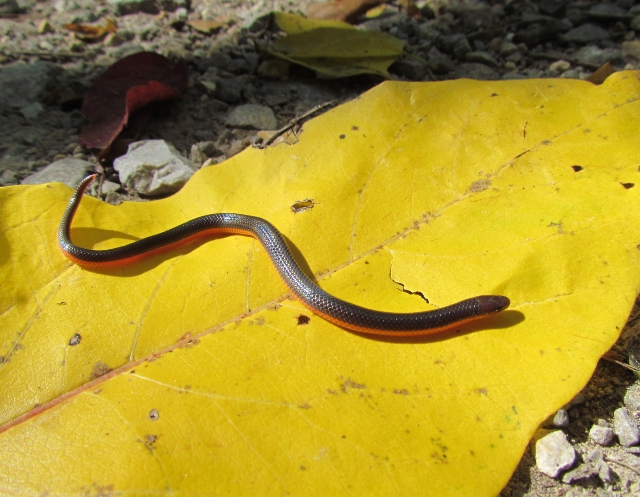
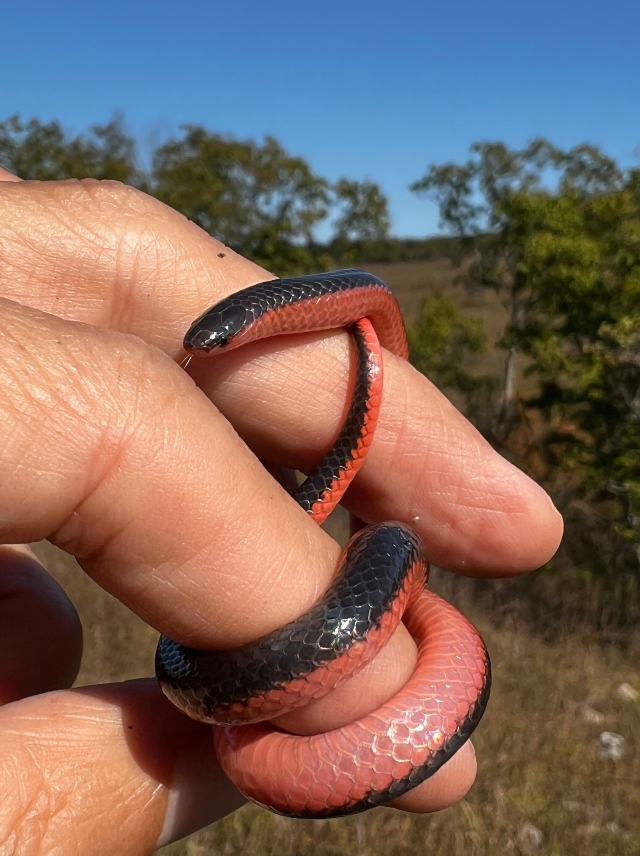
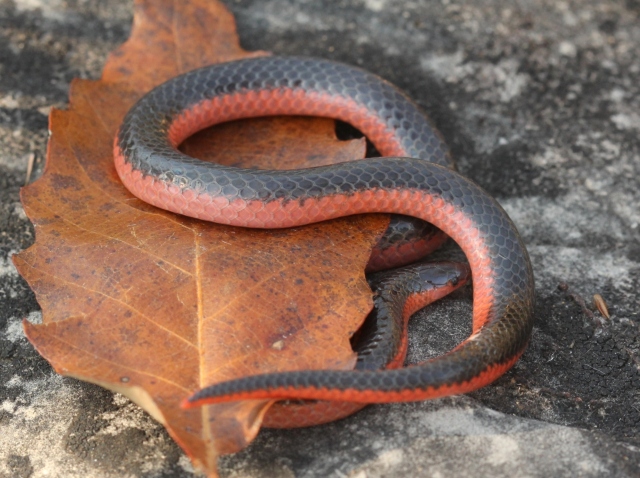
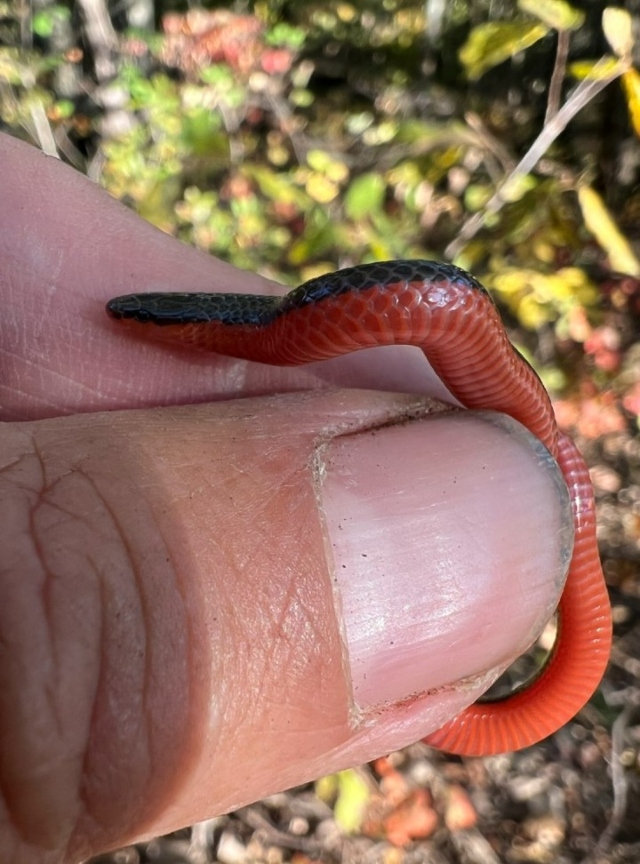
While flipping rocks in Missouri glades, I occasionally find these small serpents. This two-toned snake has an upperside color that is brown-to-black and an underside that is salmon-pink and extends up the reptile’s sides.

2 Western Worm Snake_3560

This secretive creature is less than a foot long and seldom seen. If threatened, this snake, like other snakes, can often release foul smelling musk from its cloaca. Unlike most snakes, if handled, it may press its pointy tail tip into the captor’s hand as a defense mechanism.

3 Western Worm Snake_2427

The Western Worm Snake’s diet include earthworms, slugs, and some slender, soft-bodied insect larvae such as beetle grubs. This species has a pair of enlarged teeth at the rear of its mouth that is presumed to help with swallowing earthworms.

4 Western Worm Snake_4247

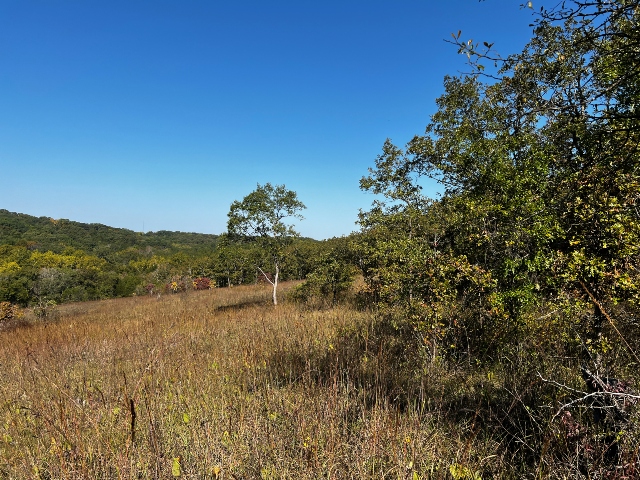
It is most often encountered on rocky, forested hillsides and on rocky, open glades, especially in the Spring and Fall. Within these larger habitats, they require slightly moist places to reside. It rarely ventures out in the open. Instead, it spends most of its time in burrows underground, under thick leaf litter, or beneath large rocks or logs.

5 Western Worm Snake_8972

Worm Snakes do not live in my area of Ohio, so it’s always cool to come across one in the wild.

Third Eye Herp
E-mail