Bull Snake

Over the weekend I took a 6 hour drive to the sandhill prairies of Illinois to look for a snake I’ve been wanting to see in the wild for quite some time – a Bull Snake. The sandhill prairies are located about a half hour south of Chicago.

It didn’t take long before I found my first snake. The Bull Snake is a large reptile, often 4-6 feet long. Occasionally it can grow to over 8 feet. This first snake was a female, about three feet long. The scale on the tip of the snake’s snout is enlarged – it is used for digging.

Since these snakes are long and heavy-bodied, they do not move particularly fast. So to defend themselves against predators, they are “master bluffers.” A Bull Snake will vibrate its tail, inflate with air, and hiss very loudly. They have a unique glottal structure that enable them to hiss louder than practically any other snake. Later on I found this four foot male.

The Bull Snake’s muscular neck, heavy skull and large scale on its snout are adaptations that enable it to root through the ground in search of they main food item: rodents. These are one of the most beneficial serpents we have in terms of keeping the rodent population in check.

Even a single Bull Snake exerts a major predatory impact around fields and stored crops where mice, rats and gophers abound.

It was a great weekend for herping; to see more photos from this trip, visit Sandhill Prairie Herping 2012.

Third Eye Herp
E-mail

Red Admiral

A recent article in the Cleveland Plain Dealer states “Red admirals are taking over Northeast Ohio.” This butterfly is identified by its striking dark brown, orange, and black wing pattern. More specifically, the dark wings possess orange bands that cross the forewings and on the outer edge of the hind wings.

An unusually high number of the insects are apparent this Spring – I’ve seen several in my backyard – especially on my shed and in the rock garden. Nobody knows for sure why every once in a while this butterfly’s population spikes. It could be climate change, a mild winter, or migrations from southern states to the northeast.

The Red Admiral has a very erratic, rapid flight. The males are territorial and many times can be found in the same location day to day. Adult butterflies prefer sap flowing from trees or fermenting fruit over nectar from flowers. Their caterpillars feed mainly on nettle. Here’s one I spotted on a tree in Zanesville, Ohio.

The undersides of the wings are a mottled brown and tan. They blend in very well forest the forest floor. This one resides at Brecksville Reservation.

Third Eye Herp
E-mail

Northern Ringneck Snake

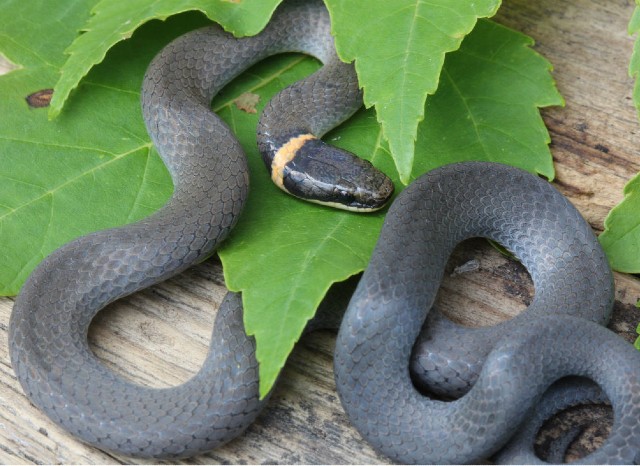
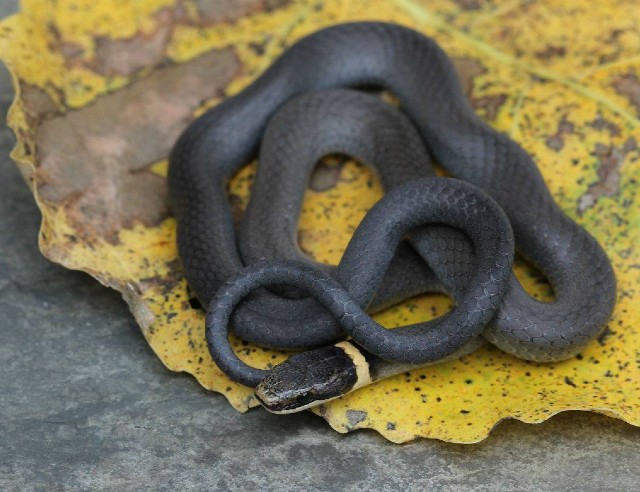
I was on a weekend biology-oriented trip with a group of high school students in central Ohio and we managed to find several Northern Ringneck Snakes. It’s pretty easy to see how these snakes get their common name.

Ringnecks enjoy coast to coast distribution across the United States, though they are absent from arid areas. This species lives throughout much of the northeastern United States. They need some degree of moisture to find their favorite food items: worms, slugs and salamanders.

ringneck snake_6217

These snakes like to hide under rocks and bark at the edges of forests, usually where a forest meets an open area like a field. They can be quite common in some places, but are secretive and not usually seen out in the open. The smooth, slate-colored scales on Ringneck Snakes have a satiny luster. The undersides of these snakes are brightly marked with yellow, orange or red.

On occasion they may curl their tail into a “bulls eye” and present the red surface to whatever is disturbing the snake. This is believed to either scare off enemies or to advertise that the snake isn’t good to eat (mammals find Ringneck Snakes to be distasteful).

A Northern Ringneck Snake that I found in northeast Ohio

They are a mild mannered, small snake – often 12 to 16 inches in length. Here’s a few of the students hanging out with the Northern Ringneck Snakes that we found on our field trip.

To  see more photos from this trip, visit Cinco de Mayo in Central Ohio.

Third Eye Herp
E-mail

Water Snakes In Love

Most of a Northern Water Snake’s activities during the month of April are spent basking in the sun. Males may not feed at all until after mating and females feed very little. Today I saw two pairs of Northern Water Snakes courting.

Males do not appear to be territorial and sometimes several males can be seen courting a female. Adult females are much larger and heavier-bodied than males. A courting male will crawl alongside a female, and rub his chin, neck or entire body against her.

There is a correlation between the size of the female and the number of offspring she will produce in August or September. Anywhere from a dozen to sixty babies are born alive, one at a time.

Baby Northern Water Snakes have black bands on a background of pale gray or light brown. As the snakes grow, their pattern fades, becoming obscure. Often adults are of an overall dark brown or black in color without any noticeable pattern.

Sunning is by far the most common activity you are likely to see Northern Water Snakes do. They can be observed on branches (like these snakes), on stone walls near waterways or on beaver lodges.

Third Eye Herp
E-mail

Skunk Cabbage

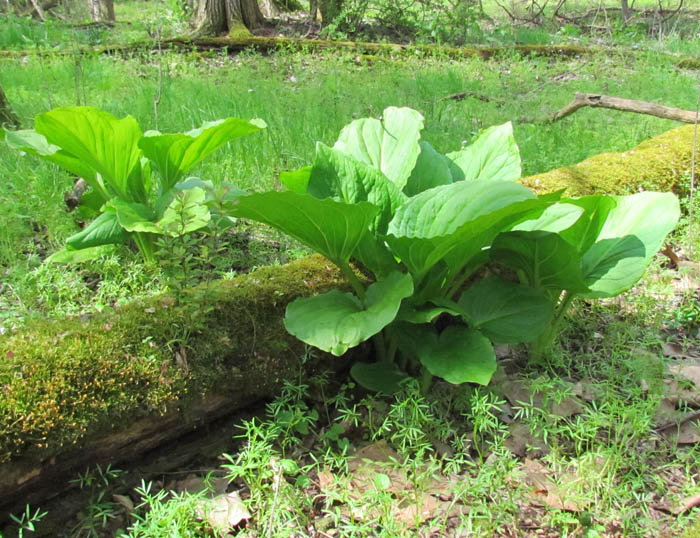
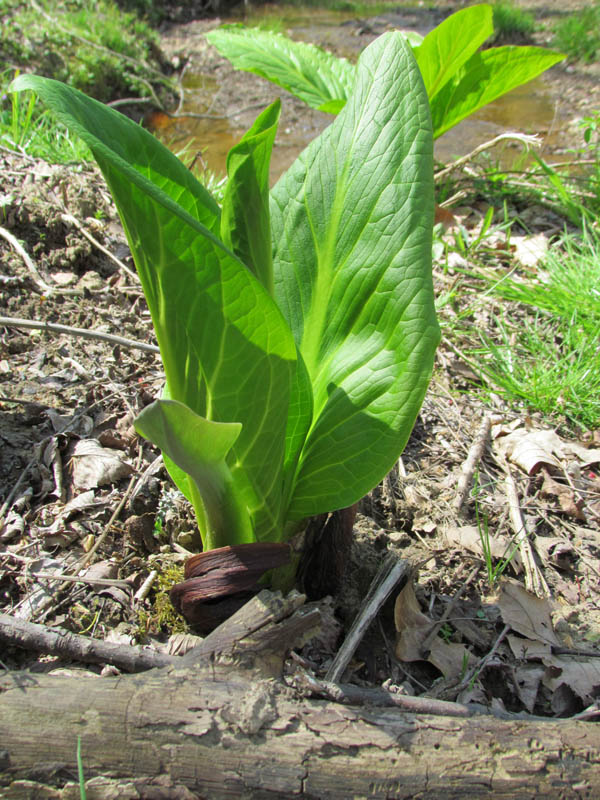
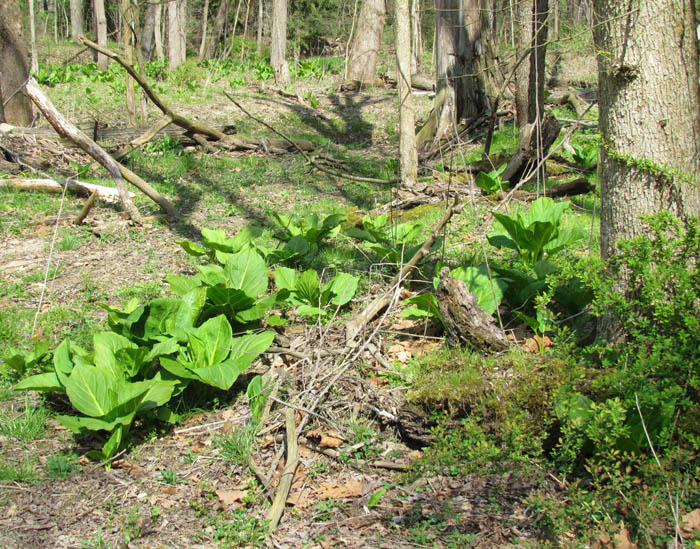
The first thing you notice about Skunk Cabbage is how surprisingly big it is. Walking through the forest and coming across this large, leafy plant makes quite an impression. It is easy to recognize, with its huge leaves rising directly from the ground.

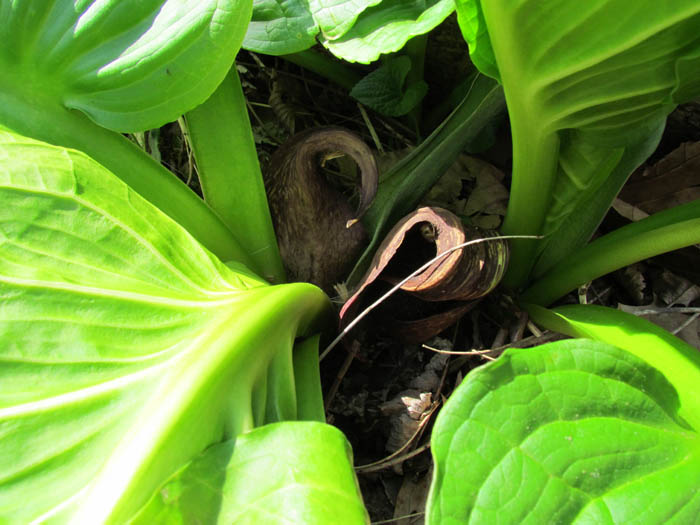
Skunk Cabbage is a low growing, foul smelling plant that prefers wetlands. It flowers early in the spring when only the flowers are visible above the mud. The stems remain buried below the surface of the soil with the leaves emerging later.

Breaking or tearing a nearly two foot long leaf produces a pungent odor, which is the source of the plant’s common name. The foul odor attracts pollinators and may also discourage large animals from disturbing or damaging the plant.

Many fly species, as well as some butterflies, bees and beetles pollinate Skunk Cabbage. In the fall, Skunk Cabbage leaves fall over and begin to rot. Small animals, including slugs, millipedes, and pillbugs eat the old leaves, but Skunk Cabbage leaves are poisonous to mammals (including us). The large fallen leaves also provide shelter for small animals.

In late winter and early spring, Skunk Cabbage has a remarkable ability to produce heat that allows it to emerge and bloom even when the ground is still frozen. When temperatures are freezing, the flower buds can warm up to 70 degrees, which melts the snow around the plant. The flowers are characterized by a mottled maroon hood-like structure.

Third Eye Herp
E-mail

A Blue Green Frog

There has been much talk in recent years of amphibian declines and it is indeed a serious issue. Research efforts are being made to try to get a better understanding of this worrisome problem. Depsite this, there are some amphibians that seem to be doing quite well. One of these is the Green Frog, it is an amphibian found over much of the eastern United States (including my backyard).

Male and female adult Green Frogs can easily be determined by the size of their eardrums. For males the tympanum (that circle you see behind the frog’s eye) is significantly larger than the eye. For females, it is about the same size as the eye. Almost any permanent body of water can be habitat for Green Frogs. Ponds, marshes, lakes swamps and the slow parts of creeks and rivers can be homes to these amphibians.

Green Frogs tend to stay close to the water’s edge, ready to leap in (and often give a squeak) if they sense danger. Warm, rainy nights will often induce young Green Frogs to make overland migrations. During these times, they are sometimes forced to take up residence in puddles or ditches until the next rain comes along. Every year I have Green Frogs make their home in my outdoor turtle enclosures, even though they have wire-screened tops. Here’s one from a couple of years ago.

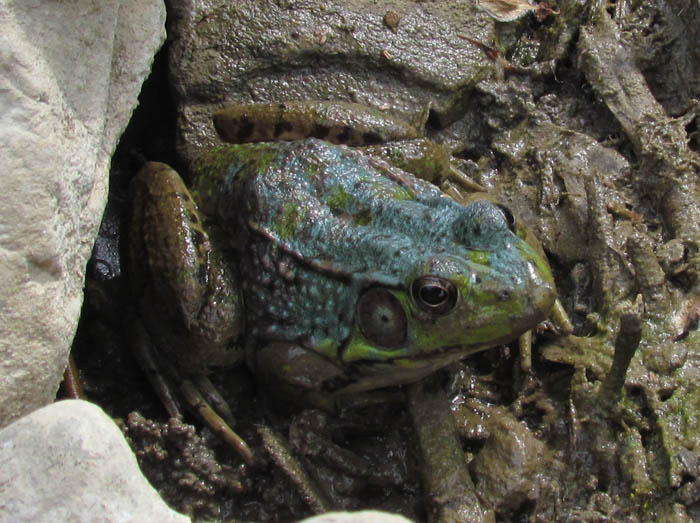
Like most wide-ranging reptiles and amphibins, Green Frogs are variable in their appearance. They make be green, brown or olive – or various combinations of these colors. In some cases, males can have quite a bit of yellow color on the chins. On occasion, Green Frogs with blue coloration turn up, like this one that I found today.

At this point it seems that Green Frogs are well adapted to succeed in a world that’s becoming increasingly modified by humans. It’s quite possible that in some places Green Frogs have increased in places where other frogs have declined. There are undoubtedly many factors that determine whether a species will succeed or decline. That’s why it is essential to study common species along with troubled ones, to better understand the ecological problems species face and how they solve them. There is still much to learn about this very common and flourishing frog.

Third Eye Herp
E-mail

Alligator Lizard Eggs

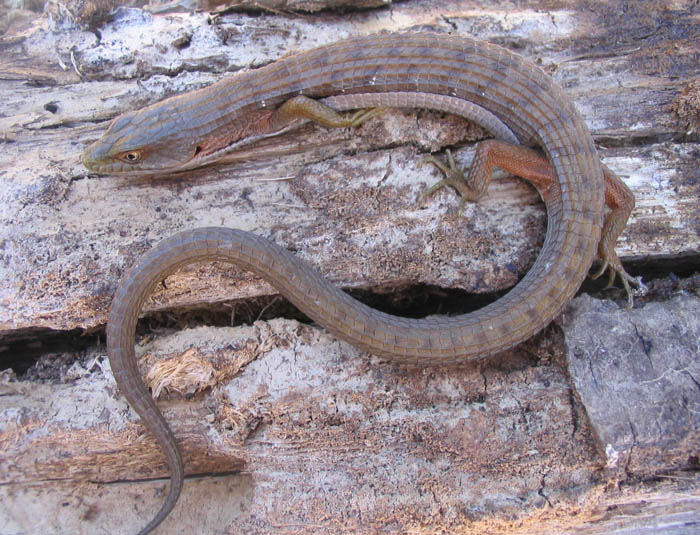
Alligator Lizards get their name from the square-shaped scales that they have on their back. They’re a relatively common lizard in the western United States. I’ve found quite a few of them in Northern California. A few years ago I brought three of them back home and set them up in this terrarium.

I was pretty sure that I had a male and two females, but I’ve never seen any breeding activity. Today was a nice day to put the lizards on the deck in a screened enclosure, so they could get some fresh air and natural sunlight.

While they were outside, I cleaned the lizards’ tank and I found eight eggs! I now have them in an incubator. If they hatch, it will be the first time I’ve ever produced Alligator Lizards.

If you’d like to see some photos of wild Alligator Lizards, check out my Herping California Pics.

Third Eye Herp
E-mail

Question Mark Butterfly

A few of these orange and brown butterflies were seen fluttering about today. The Question Mark Butterfly gets its name from a little silver marking on its wings which you can see when it has its wings folded in its resting position.

The color of the top of the hindwing changes depending on the time of year. In the summer, it is mostly black with a short tail, the winter form has a lot of orange and a longer, violet-tipped tail. The underside is light brown; hiding in cracks and crevices of wood, they remain inactive through the cold months. Their colors help keep them hidden and safe.

The Question Mark is found primarily in wooded areas that have open spaces, such as city parks and fence rows. Adult males will sit during the afternoon hours on tree trunks waiting for females. They’ll leave their perches to chase away other insects and even birds. Some adults stay in the northern United States to hibernate, while others migrate south. Butterflies that hibernate are among the longest lived butterflies in Ohio.

Third Eye Herp
E-mail

Flowering Dogwood

Although the woods are mostly brown today with only a few trees sprouting leaves, there’s still plenty of beauty to be found, especially in the showy blooms of Flowering Dogwood.

Flowering Dogwood is fairly small, usually 20-30 feet tall. It is a useful tree not only for its eye-catching appeal in the springtime, but its berry-like fruit is eaten by many bird species as well as other animals in the autumn.

The dogwood sprouts tiny greenish-yellow flowers in clusters, with each flower surrounded by four large white bracts (often incorrectly labeled as petals). It is considered by many the most spectacular of the native, flowering trees.

There is much Christian religious folklore surrounding this tree. The blooms often appear in the shape of a cross, with holes in the tips of the pedals signifying the nails that were driven into the cross. If you look closely at these holes you can notice a faint red stain representing the blood. In the center you will find a green bloom symbolizing the crown of thorns placed on the head of Jesus.

Third Eye Herp
E-mail

Russian Rat Snake Eggs

It can be difficult adjusting to being back in the Greater Cleveland Area after 10 days of vacation in California. Especially with the two days of snow we had earlier this week. A nice “consolation prize” was my first clutch of snake eggs this year. This clutch was from a Russian Ratsnake.

These are active and personable pets that are among my favorites. They typically have a dozen eggs. If you’d like to learn more about Russian Rat Snakes, check out my article in “Reptiles” magazine titled Black Russians.

Third Eye Herp
E-mail