Bull Snake

Over the weekend I took a 6 hour drive to the sandhill prairies of Illinois to look for a snake I’ve been wanting to see in the wild for quite some time – a Bull Snake. The sandhill prairies are located about a half hour south of Chicago.

It didn’t take long before I found my first snake. The Bull Snake is a large reptile, often 4-6 feet long. Occasionally it can grow to over 8 feet. This first snake was a female, about three feet long. The scale on the tip of the snake’s snout is enlarged – it is used for digging.

Since these snakes are long and heavy-bodied, they do not move particularly fast. So to defend themselves against predators, they are “master bluffers.” A Bull Snake will vibrate its tail, inflate with air, and hiss very loudly. They have a unique glottal structure that enable them to hiss louder than practically any other snake. Later on I found this four foot male.

The Bull Snake’s muscular neck, heavy skull and large scale on its snout are adaptations that enable it to root through the ground in search of they main food item: rodents. These are one of the most beneficial serpents we have in terms of keeping the rodent population in check.

Even a single Bull Snake exerts a major predatory impact around fields and stored crops where mice, rats and gophers abound.

It was a great weekend for herping; to see more photos from this trip, visit Sandhill Prairie Herping 2012.

Third Eye Herp
E-mail

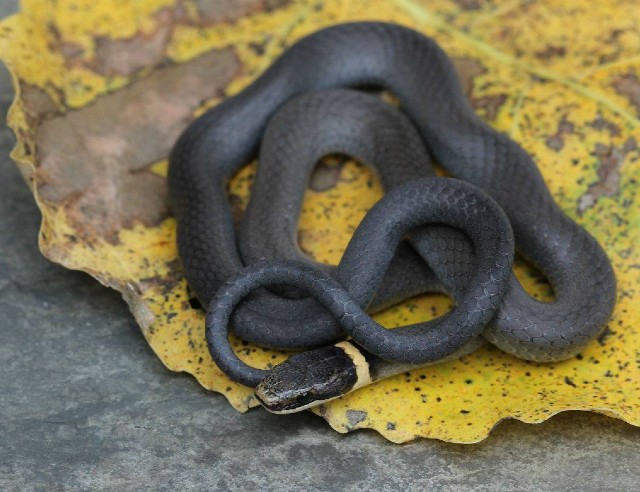
Northern Ringneck Snake

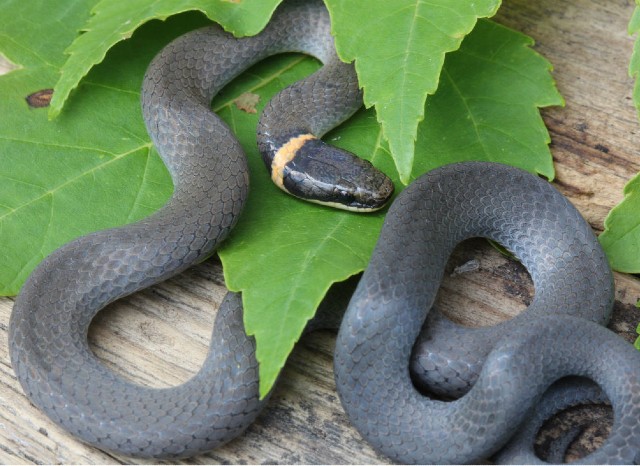
I was on a weekend biology-oriented trip with a group of high school students in central Ohio and we managed to find several Northern Ringneck Snakes. It’s pretty easy to see how these snakes get their common name.

Ringnecks enjoy coast to coast distribution across the United States, though they are absent from arid areas. This species lives throughout much of the northeastern United States. They need some degree of moisture to find their favorite food items: worms, slugs and salamanders.

ringneck snake_6217

These snakes like to hide under rocks and bark at the edges of forests, usually where a forest meets an open area like a field. They can be quite common in some places, but are secretive and not usually seen out in the open. The smooth, slate-colored scales on Ringneck Snakes have a satiny luster. The undersides of these snakes are brightly marked with yellow, orange or red.

On occasion they may curl their tail into a “bulls eye” and present the red surface to whatever is disturbing the snake. This is believed to either scare off enemies or to advertise that the snake isn’t good to eat (mammals find Ringneck Snakes to be distasteful).

A Northern Ringneck Snake that I found in northeast Ohio

They are a mild mannered, small snake – often 12 to 16 inches in length. Here’s a few of the students hanging out with the Northern Ringneck Snakes that we found on our field trip.

To  see more photos from this trip, visit Cinco de Mayo in Central Ohio.

Third Eye Herp
E-mail

Water Snakes In Love

Most of a Northern Water Snake’s activities during the month of April are spent basking in the sun. Males may not feed at all until after mating and females feed very little. Today I saw two pairs of Northern Water Snakes courting.

Males do not appear to be territorial and sometimes several males can be seen courting a female. Adult females are much larger and heavier-bodied than males. A courting male will crawl alongside a female, and rub his chin, neck or entire body against her.

There is a correlation between the size of the female and the number of offspring she will produce in August or September. Anywhere from a dozen to sixty babies are born alive, one at a time.

Baby Northern Water Snakes have black bands on a background of pale gray or light brown. As the snakes grow, their pattern fades, becoming obscure. Often adults are of an overall dark brown or black in color without any noticeable pattern.

Sunning is by far the most common activity you are likely to see Northern Water Snakes do. They can be observed on branches (like these snakes), on stone walls near waterways or on beaver lodges.

Third Eye Herp
E-mail