Yellow Sac Spider

yellow spider_11_13 014

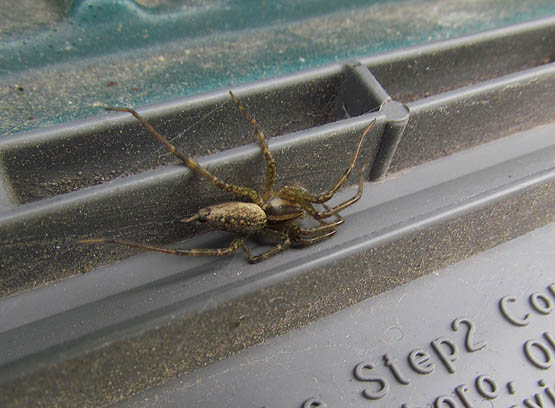
Normally these are outdoor spiders, but sac spiders often invade structures (like my house). Their numbers increase significantly in the Autumn when the weather turns cool and their food supply disappears.
yellow spider_11_12 025

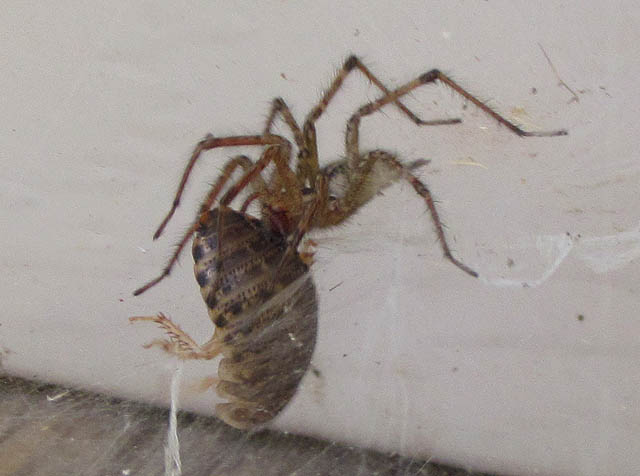
If there is food available, sac spiders can become established indoors. At night they actively search for small insects. When hunting, they run quickly while waving their forelegs in front of them. Their front legs are longer than their other three pairs of legs.

yellow spider_11_13 011

Indoors, they can be observed on walls and ceilings, but they quickly drop to the floor and seek cover when disturbed. Yellow Sac Spiders construct a silken tube or sac in a protected area, such as within a leaf, under a log, or at the junction of a wall and ceiling.
yellow spider_11_12 004

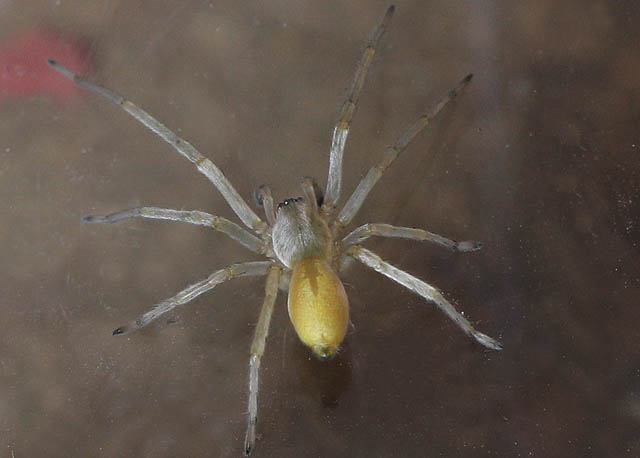
They use this sac as their daytime retreat; this is how the sac spider gets its name. These spiders do not build webs. Outdoors, this species occupies a wide variety of habitats, including trees, the forest floor, fruit orchards and other agricultural areas, as well as shrubs surrounding open fields.
yellow spider_11_12 009

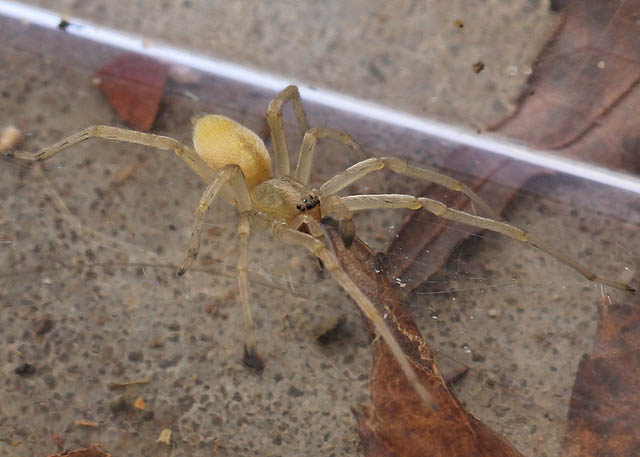
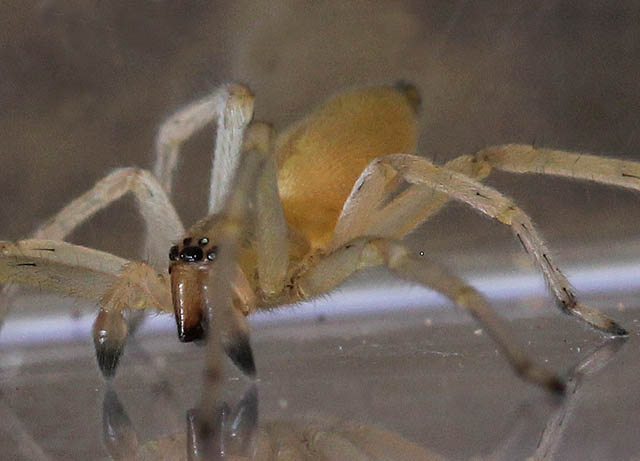
These creatures are usually pale in color and can range from yellow to beige. They are quite small (about 1/2 inch long) and easy to overlook, with no distinct markings.

yellow spider_11_11 017

This species has eight simple eyes aligned in two rows of four, consisting of secondary and primary eyes. Secondary eyes are light sensitive and are used to track movement. Primary eyes are the only set of movable eyes and are used to view close objects.
Third Eye Herp
E-mail

Grass Spider

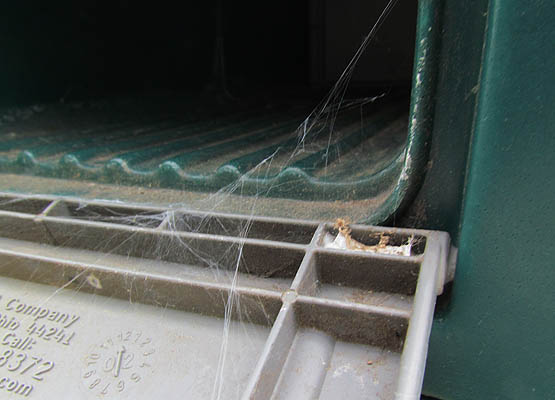
A couple of weeks ago when I went out to get the mail and opened the back door or the mailbox, I saw a spiderweb. It was apparent that a spider was living in there.

grass spider_4546

I thought it was nice to have an insect-free mailbox, with the spider quickly ridding it of any small creature that happened to wander inside it. I mean, who wants bugs in their mailbox?

grass spider_4540

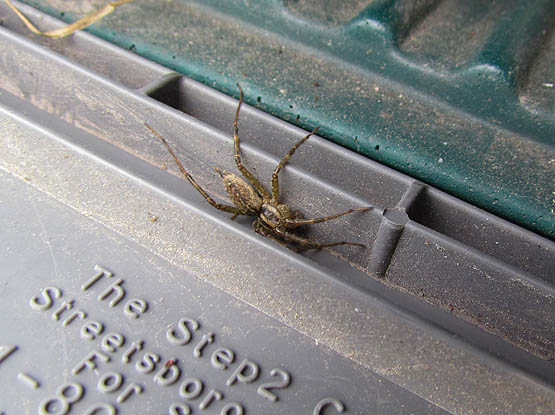
The mailman, however, had a different point of view on the subject and did not share my enthusiasm. I have a rock garden in my backyard with plenty of crickets. They sing all the time. So I removed the spider from the mailbox and released him into the garden. You have to keep the mailman happy.

 grass spider_4547

I kind of missed seeing my 8-legged friend in the days that followed. But recently I went out to get the mail and guess what?

grass spider_4543

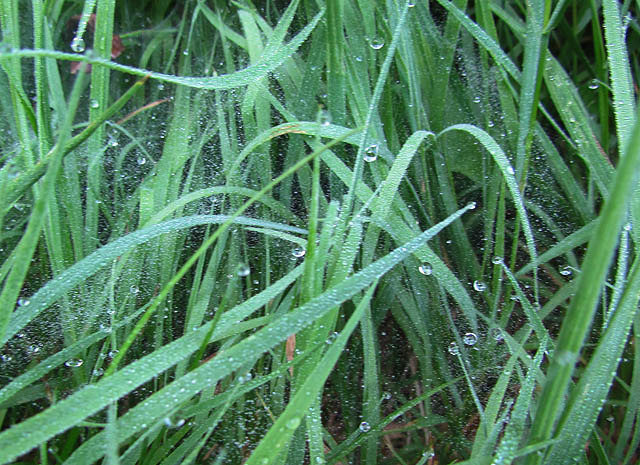
Grass Spiders are commonly seen in Ohio and are classified as funnel web weavers. The structures they build are recognized by the large, somewhat concave, mostly horizontal, sheet-like web with a funnel or tunnel located off to one side.

grass spider_4712

The webs are found on grass, weeds, ground cover and in exterior places such as fencerows, bushes, brush piles, houses and garages. Funnel weavers and grass spiders build their funnel-shaped webs close to the ground. They hide in the narrow end of the funnel, which is usually protected by leaves or rocks.

grass spider_4579

Juvenile Grass Spiders emerge from the egg case in Spring and begin constructing miniature versions of typical webs. Throughout the weeks that follow, the web is enlarged, and by late Summer it can be quite sizeable.

grass spider_4914

Sometimes the web has a thin tangle of threads above the sheet. These act as “knock-down” threads for flying insects. After hitting these threads, the flying insect tumbles onto the sheet and is attacked by the spider.

grass spider_4718

Many common funnel weavers are also characterized by having bristly legs, which may aid in sensing prey. When an insect, spider, or other small creature crosses the wide end of the funnel, the spider feels the vibration and rushes out to grab its food.

grass spider_4918

The silk of this spider’s web is not adhesive. The Grass Spider relies upon lightning reflexes to dash out and grapple with its prey on the sheet. They are valuable to humans because they keep the insect population in check.

grass spider_5263

There is an old saying about Grass Spiders: When there is dew on their webs in the morning, it will be a beautiful day. 

Third Eye Herp
E-mail

Giant Carolina Wolf Spider

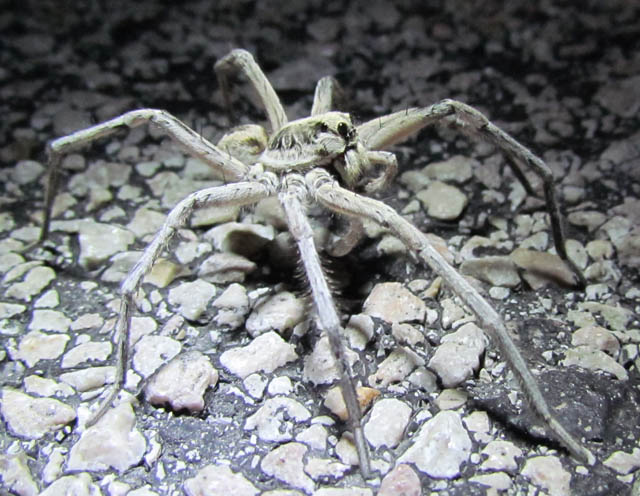
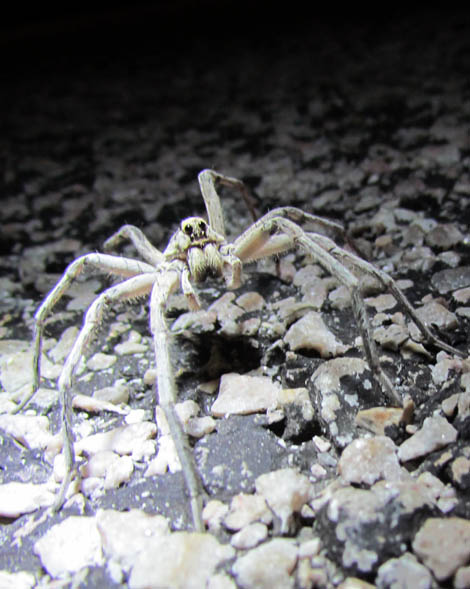
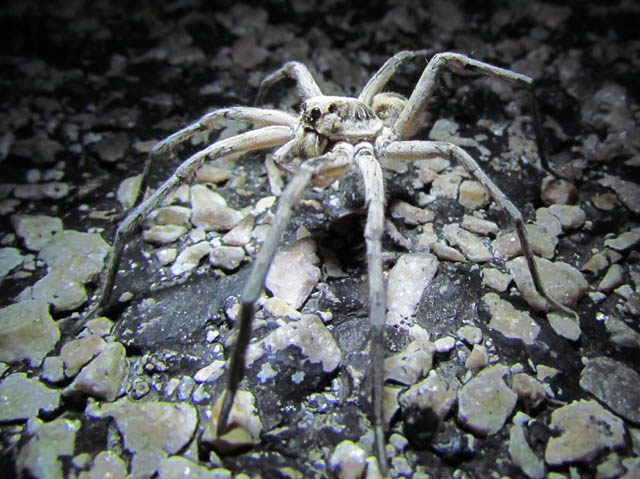
Driving remote roads at night, I can see the green reflections from the eyes of large invertebrates on the pavement.

Wolf Spider_7982

Wolf Spiders do not build webs to catch their food. Instead they use their vision and their sensitivity to vibrations to hunt for prey.

Wolf Spider_8034

This creature has eight eyes that are arranged in three rows. The bottom row has four small eyes, the middle row has two very large eyes and the top row has two medium-sized eyes.

Wolf Spider_8035

This is a pretty large spider – with a three to four inch legspan.  It may hunt actively at night or wait in ambush at the mouth of its burrow, where it hides during the day. Wolf Spiders are unique among their species because the females carry their eggs along with them in a round silken egg sack attached to their abdomens.

Wolf Spider_8047

Immediately after the babies hatch and emerge from their protective case, they climb up their mother’s legs like a ladder and all crowd together on her back. Here they’ll stay for a few weeks until they’re large enough to hunt on their own.

Third Eye Herp
E-mail

False Tarantula

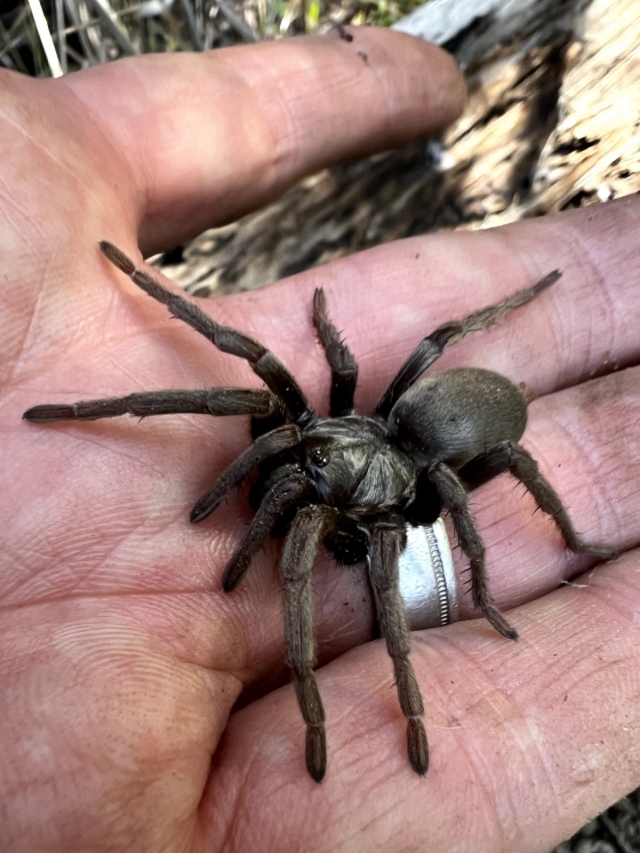
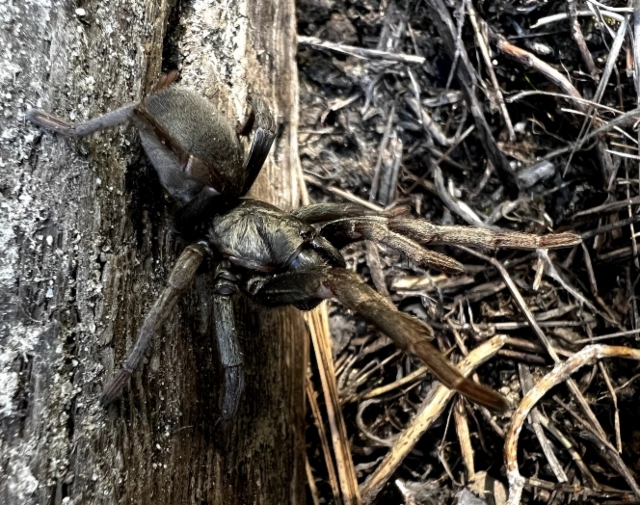
By looking under a rock found on a hillside, I found the biggest wild spider I’ve ever seen – a False Tarantula. These creatures are about the same size as the local tarantulas but they are in a different family of spiders.

False Tarantula_7758 (1)

These spiders usually safely hidden in their self-made caves; wandering males are what most people tend to encounter. They share many similar characteristics as “real” tarantulas, which is why the two are often confused.

False Tarantula_1109 (1)

False Tarantulas occur all over California from sea level to the high Sierra Nevada Mountains. Their reclusive habits and nocturnal behavior keep them hidden from view most of the time, so they aren’t commonly encountered.

It is brown to silver gray in color and has fine hairs all over its entire body. This tarantula look-alike behaves much like its larger cousin.  If threatened, it will rear up and expose its fangs as a warning to its perceived attacker. Finding this big arachnid was one of the highlights of my California trip.

False Tarantula_1120

Third Eye Herp
E-mail

Black and Yellow Garden Spider

Around here the largest spider you’re likely to come across is this one. Many people are freaked out by it’s size and bold coloration, especially when they encounter one unexpectedly.

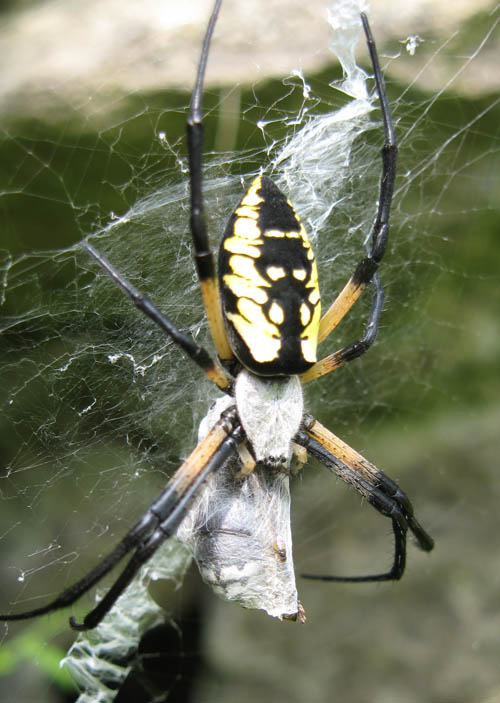
Its web is a distinctive circular shape up to two feet in diameter, with a dense zigzag of silk, known as a stabilimentum, in the center. The purpose of the stabilimentum is disputed. It is possible that it acts as camouflage for the spider lurking in the web’s center, but it may also warn birds of the presence of the otherwise difficult-to-see web.

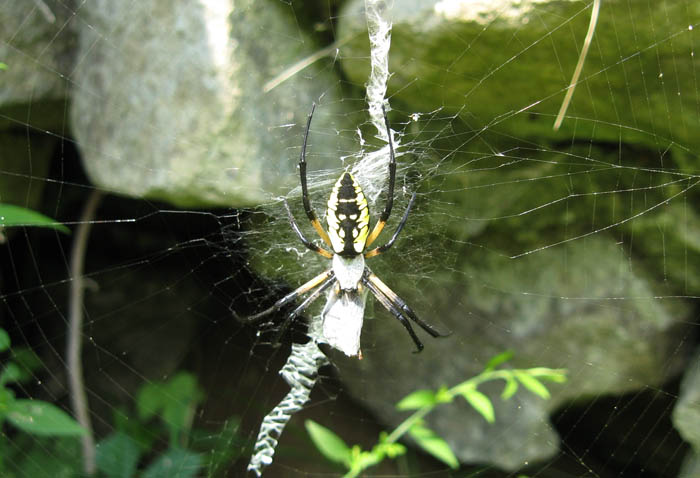
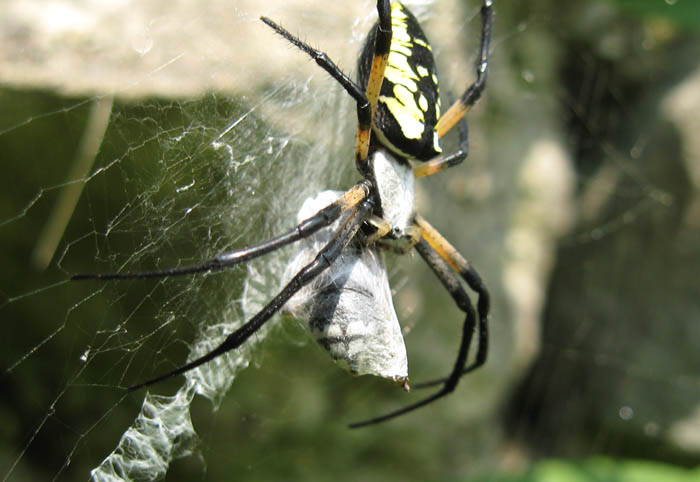
In a nightly ritual, the spider consumes the circular interior part of the web and then rebuilds it each morning with fresh new silk. This spider, found on the Erie Canal towpath, has caught a hornet.

As is true in many spider species, females of this species grow to much larger size than males. Black and Yellow Garden Spiders are harmless to humans. Because they are large, many people fear them; however, not only are they harmless, but they are beneficial because they eat a lot of insects.

Third Eye Herp
E-mail