Common Raven

The Common Raven has accompanied people around the Northern Hemisphere for centuries, following their wagons and hunting parties in hopes of a quick meal.

These birds are surprisingly large. They aren’t as social as crows; they tend to be seen alone or in pairs. Their throat is covered by thick and shaggy feathers and they have a thick, heavy bill.

Common Ravens prefer open landscapes, such as tundra, seacoasts, open riverbanks, rocky cliffs, mountain forests, plains, deserts, and scrubby woodlands. They store foods of all kinds, including nuts, bones, eggs, and meat.

These birds are very important in native cultures throughout their range. They an important mythic creature in western Native American traditions. In many cultures they are viewed as a symbol of wisdom, fertility and creation.
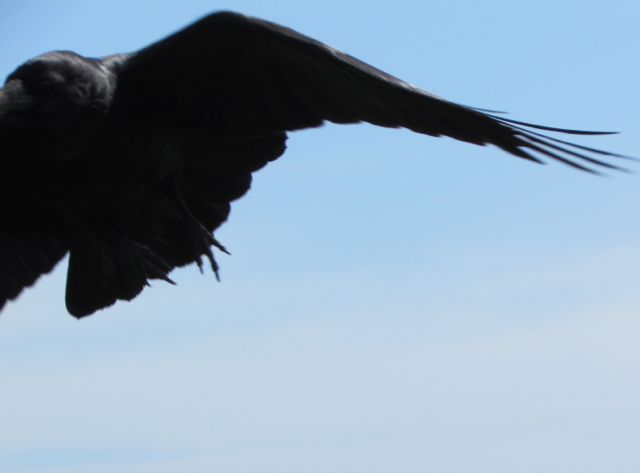
Unlike crows, Common Ravens typically soar and glide. On this windy day near the ocean, they would often hover on wind currents, remaining suspended in the air. They are acrobatic fliers and have been observed flying upside down for as far as one kilometer.

Common Ravens engage in seemingly playful acts such as yanking the tails of cats and dogs. They are among the smartest of all birds and are capable of learning innovative solutions to newly encountered problems.

Third Eye Herp
E-mail

Black-capped Chickadee

Black-capped Chickadees are one of the most easily recognized birds in Northern Ohio. Their inquisitive behavior and friendly demeanor make them a regular visitor to birdfeeders.

They are small, with a solid black “cap” and “bib.” Males and females look alike. Their vocalizations are of one of the most complex in the animal kingdom.

Depending on slight variations in the phrases, their call can convey separate, unique messages: in addition to acting as a contact call or as an alarm call, chickadees also use their voice to relay information about an individual’s identity or to indicate that they recognize a particular flock.

These birds spend most of their day searching for food. They move along stems and branches of trees and shrubs, searching crevices for insects. In Winter, insect and spider eggs make up half their diet while seeds, berries and other plant matter account for the other half.

When food is plentiful, Black-capped Chickadees store it away. They stash food under bark or in patches of lichen. A single chickadee may stockpile hundreds of food items in a day, placing each item in a different spot. Not only can they remember thousands of their food hiding places, but they can also remember where they have hidden their stored foods for up to a month.

On cold winter nights, Black-capped Chickadees conserve energy by lowering their body temperature by 10 to 15 degrees F.  While this may seem counterproductive, “nocturnal hypothermia” probably reduces energy expenditure by as much as ten percent.

A compact, cheerfully sociable bird, the energetic Black-capped Chickadee does not migrate – allowing us to enjoy it all year long.

Third Eye Herp
E-mail

Pileated Woodpecker

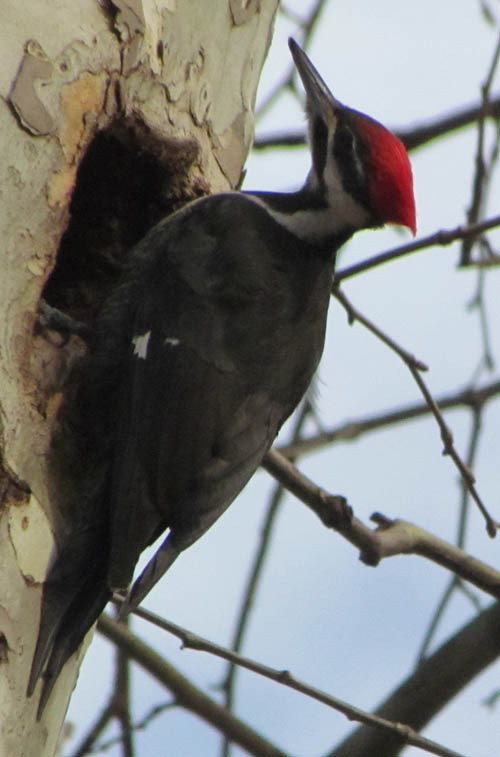
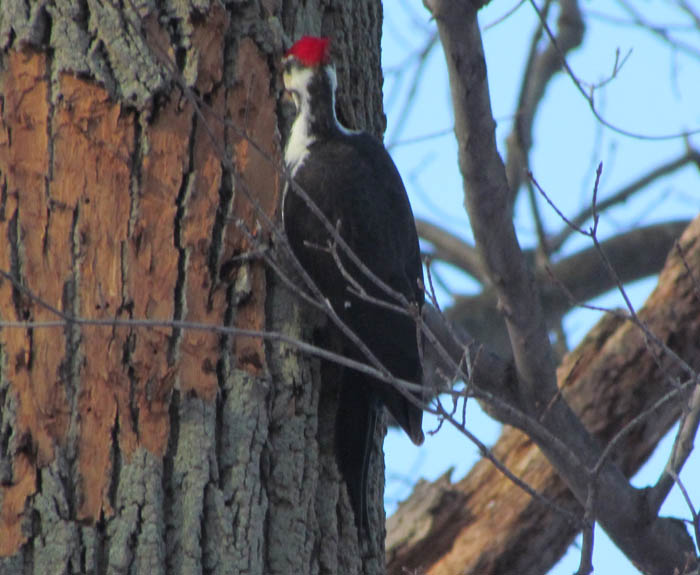
Sometimes the best way to find cool wildlife is not by watching, but rather by listening. As I walked through the woods, I heard a noise that got my attention. The Pileated Woodpecker is one of the biggest, most striking forest birds on the continent.

Males can be differentiated from females by their red “mustache” and red crest extending from the forehead, rather than starting at the crown of the head.

This crow-sized bird is quite secretive and more often seen than heard. Its call is often described as a maniacal jungle animal sound, somewhat like a monkey.

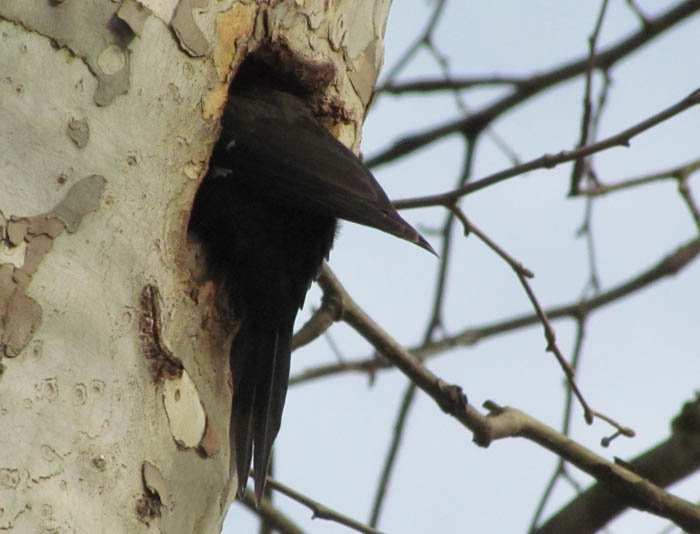
Pileated Woodpeckers excavate holes in trees for food storage and nests. The cavities are also utilized by other animals, such as ducks, owls, snakes and squirrels. Unlike  the cavities created by other woodpeckers, the holes they create are rectangular, rather than circular in shape.

Pileated Woodpeckers stay with the same mate for life. Pairs of these birds establish forest territories of 150 acres or larger in woodlands where many large trees are present. They drum on trees with their beaks to attract mates and to announce the boundaries of their territories.

This one is using its powerful, chisel-like beak to pry off tree bark in search of its main food, Carpenter Ants. It uses its long, sticky tongue to poke into holes and drag out the ants. They also eat wood-boring beetles, as well as wild fruits and nuts.

Seeing one of these birds is always a noteworthy experience. I have a pair that live in my neighborhood and sometimes they visit my backyard.

Third Eye Herp
E-mail

Northern Mockingbird

Northern Mockingbirds are highly skilled mimics that can imitate many calls of other bird species so well that even experienced birders can be fooled. They don’t limit their abilities to just bird calls – human whistles, truck backup beeps and sirens are all in their range of sound reproduction.

Its Latin species name, polyglottos translates to meaning “many tongues.” Mockingbirds establish territories and drive off invaders including Red-tailed Hawks and cats. Ohio is the northern edge of this essentially southern bird’s range and though usually found in the southern two-thirds of the state, I’ve been seeing them regularly in Cuyahoga County lately.

These not particularly flashy, slender-bodied gray birds apparently pour all their “color” into their personalities. They sing almost endlessly, sometimes even at night. The Northern Mockingbird is a relatively unremarkable bird to look at but a spectacular one to listen to.

It enjoys making its presence known by usually sitting conspicuously on high vegetation, fences, eaves, or telephone wires. This one was in the uppermost reaches of a tree.

This bird is featured in the title and as a central metaphor of the novel To Kill a Mockingbird, by Harper Lee. In the story, mockingbirds are portrayed as innocent and generous, and two of the main characters say it is a sin to kill a mockingbird because, “they don’t do one thing for us but make music for us to enjoy…they don’t do one thing but sing their hearts out for us.”

Third Eye Herp
E-mail

Cedar Waxwing

I never really notice Cedar Waxwings until autumn, when shrubs are full of ripe berries. It is at this time that the birds can congregate in large numbers on a readily available food source.

Cedar Waxwings have a rather regal appearance, they strike a commanding pose with their erect profile. But their “unapproachable” image belies their gregarious, highly social nature. Groups of them evoke a party-like atmosphere. Several Cedar Waxwings sitting in a row will pass a berry or insect from one to another up and down the row until finally one bird decides to swallow it.

These birds do not appear to establish territories and are almost always encountered in groups. Their diet of cyclically available fruit probably causes the “safety in numbers” lifestyle they have due to their nomadic wanderings in search of food.

Thier “proper image” contrasts sharply with this bird’s propensity toward over-eating and constant chatter. Cedar Waxwings have been reported to devour an entire fruit crop of Red Cedars over a two-day period. Such feats have earned it an alternative name, the “Cedar Bird.” It is probably an important seed disperser of Red Cedar (as well as other fruit-bearing trees and shrubs).

Though fruit is its mainstay, insects are consumed during summer.  While they will eat a wide range of bugs, they are particularly fond of caterpillars. They are excellent flycatchers, too.

The Cedar Waxwing prefers forest “edges” or open woodlands as a general habitat.

Third Eye Herp
E-mail

Cardinals in a Snowstorm

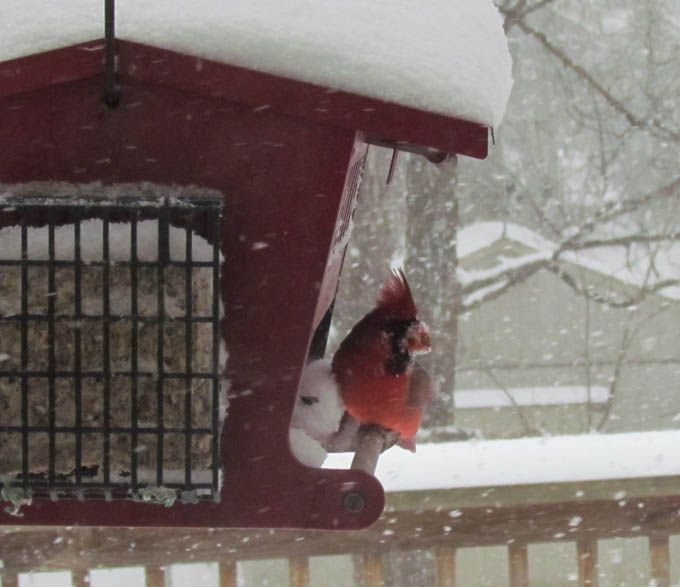
A decent snow storm hit the Greater Cleveland area this morning with white-out conditions and wind chill readings below zero at times. Here are a couple of Cardinals in my backyard weathering the storm.

Even non-birders recognize Cardinals, which are the mascot for the Arizona National Football League team and the St. Louis Major League Baseball team. They are the state bird of Ohio (as well as the state bird of six other states). Cardinals are named after highly ranked church officials who wear bright red robes and caps.

They are non-migratory birds and most live within a mile of where they were born. Cardinals are songbirds, but unlike most northern songbirds, the female also sings.

Cardinals often visit bird feeders and I bet they sure are glad that on a day like today they have easy access to a food source.

Third Eye Herp
E-mail